
Spend Less, Live Better
Why intentional design is the most financially sound decision you can make for your home right now.
A note from Angela
If you're feeling uncertain about your home right now - what to do with it, whether to invest, where to begin - I'd love to have a conversation to help you think clearly about what you actually need. Remember, clarity equals peace of mind. It's where every beautifully considered home begins.
The real cost of impulse
Most people don't arrive at an over-furnished, underperforming home all at once. It happens incrementally - a sofa bought in a hurry when the old one broke, a rug that seemed right in the shop but never settled in the space, a dining table inherited and kept out of inertia. Each individual decision felt reasonable at the time. Collectively, they created a home that doesn't work, and consistently costs money to maintain, replace, or work around.
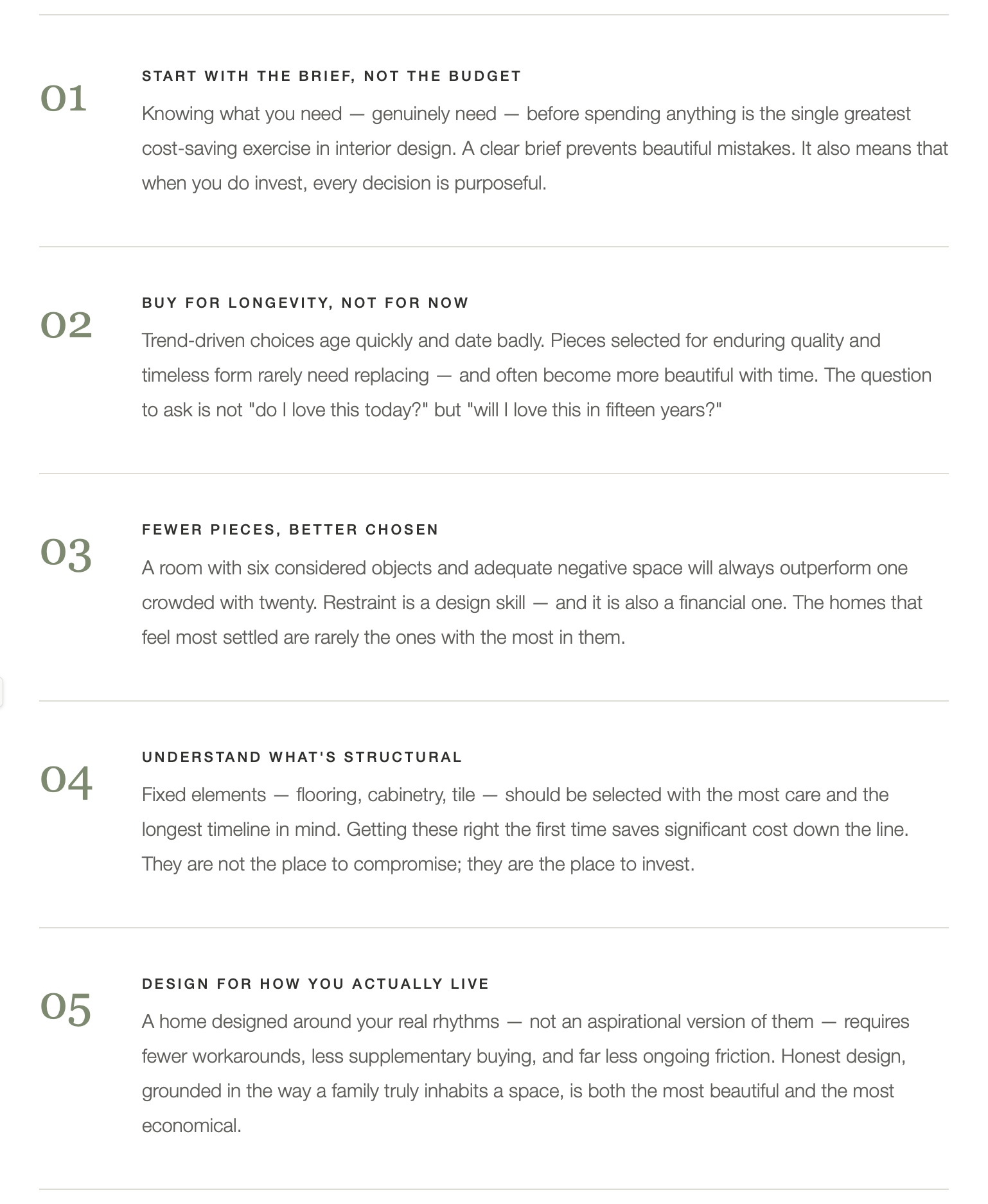
Five principles of intentional design that protect your investment
"Intentional design isn't about spending more. It's about never having to spend again on the same thing."
In uncertain times, the most financially grounded decision you can make for your home is also the most considered one. These five principles are the foundation of how we work, and how we help our clients spend once, and spend well.
The real cost of waiting
We often hear: "We're going to wait until things settle down." It's a completely understandable instinct. But it's worth examining what waiting actually looks like in practice. It usually means continuing to live in a space that doesn't serve you - buying stopgap solutions, deferring decisions that then become more expensive, and arriving at the same point twelve months later having spent money in the interim with nothing cohesive to show for it.
Thoughtful design doesn't require a full renovation. It begins with clarity about your space, your life, your priorities. That clarity is something we can help you find, at whatever scale feels right for you.
Spend wisely
The clients who feel the most settled in their homes and who spent the least amount getting there, were willing to slow down before spending. They asked deeper questions about what they actually needed. They trusted the process enough to wait for the right piece rather than filling a space quickly. And they engaged with design as a relationship, not a transaction.
In each of those homes, there's a quality that's hard to name. A sense that everything belongs, that nothing is accidental, that the space is working with the people who live in it. That quality isn't expensive to achieve. But it does require intention.